Grigri Belay Competency Test for Rescue Loads
Testing the Petzl Grigri for two-person rescue operations using the British Columbia Drop Test Method
Derek DeBruin, Nadav Oakes, John Sohl • 2023
Key Findings
Summary of test results under various rope conditions
Passes with Proper Setup
Met all safety standards with brake hand + redirect carabiner
Wet Rope Caution
Use Munter hitch on redirect for additional friction with wet ropes
Force: 4-7 kN
Well below the 12 kN maximum threshold
Slip: 38-92 cm
Within acceptable range with proper configuration
Test Overview
Purpose
This study evaluated the Petzl Grigri as a descent control device (DCD) for rope rescue systems in mountain, backcountry, remote, and tactical environments. The goal was to determine if this lightweight, versatile device could meet "rescue rated" standards for two-person loads.
Test Method
The British Columbia Drop Test Method (BCDTM) standard requires:
- 200 kg mass falling 1 meter onto 3 meters of low-stretch rope
- Maximum 1 meter of fall arrest distance (slip + rope elongation)
- Maximum 12 kN arresting force at the anchor
- Device must remain operational after the fall
Test Conditions
Rope Conditions
- • New, dry rope
- • Used, dry rope
- • New, wet rope (soaked 5+ hours)
- • Used, wet rope
Brake Configurations
- • No brake hand (unattended)
- • Brake hand only
- • Brake hand + redirect carabiner
- • Brake hand + Munter hitch
Primary testing used Sterling 9.5mm Tactical Response Rope with Technora sheath, representative of modern lightweight rescue systems.
Key Results
Passing Configuration
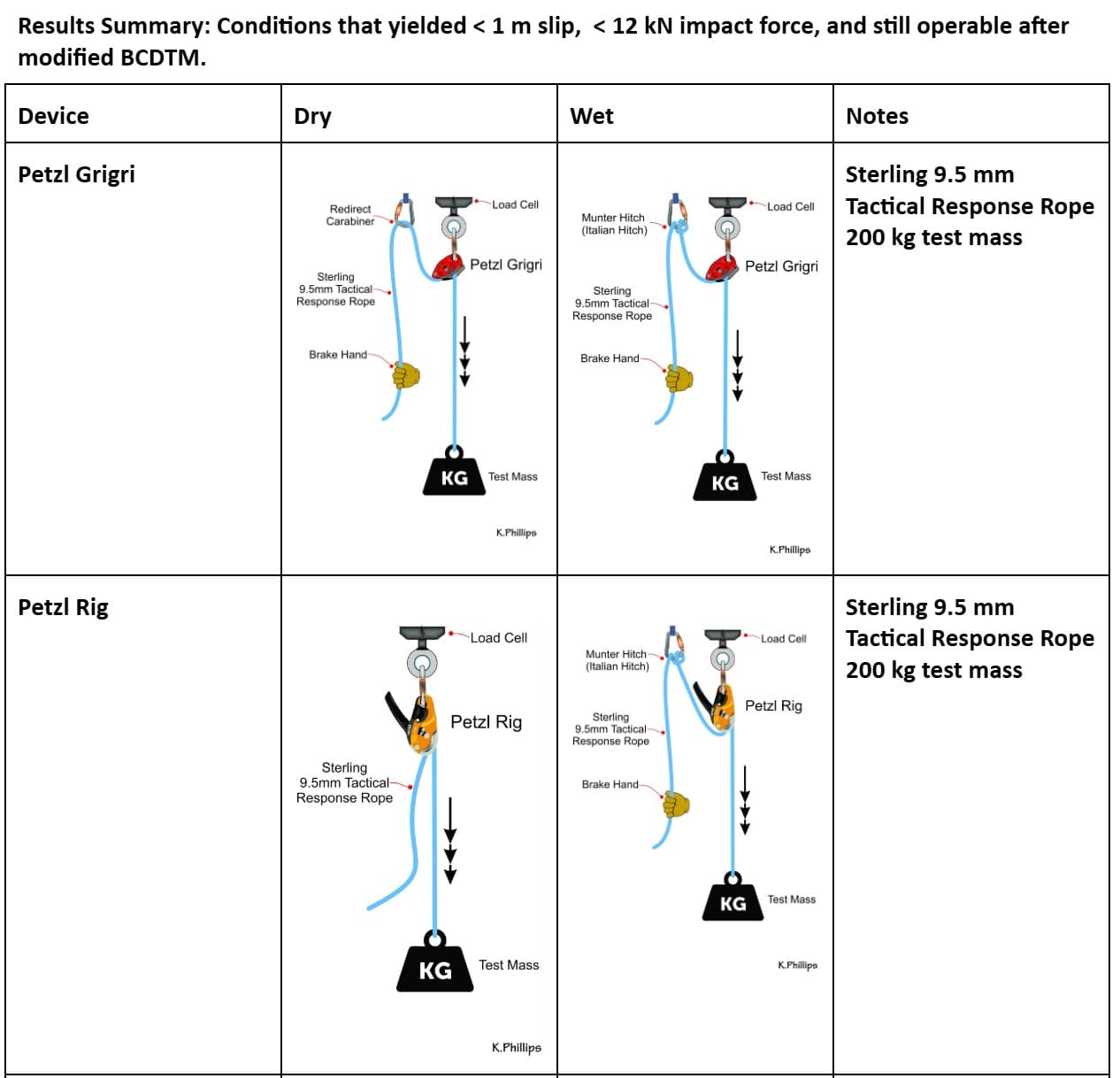
Setup: Grigri with brake hand + redirect carabiner (or Munter hitch for wet rope)
- • Force: Median 5.7 kN (dry), 4.4-6.9 kN (wet) - all well below 12 kN limit
- • Slip: Median 65.5 cm (dry), 53.5-92 cm (wet) - all under 100 cm limit
- • Device Status: Remained operational in all tests
Comparison with Other Devices
| Device | Dry Condition | Wet Condition |
|---|---|---|
| Petzl Grigri | ✓ Pass (with redirect) | ✓ Pass (with Munter) |
| Petzl Rig | ✓ Pass (unattended) | ✓ Pass (with Munter) |
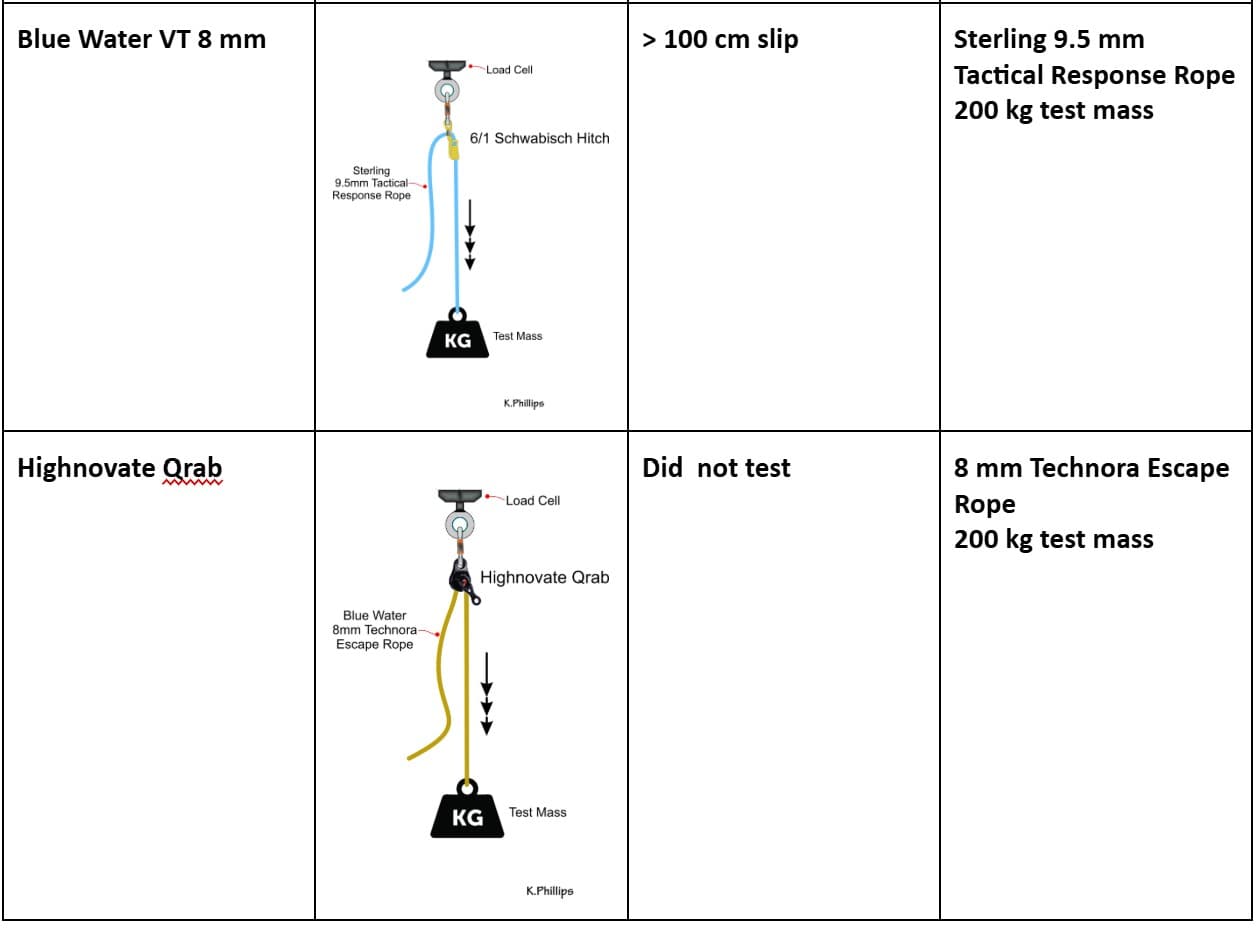
| VT Prusik (6/1) | ✓ Pass (unattended) | ~ Variable results |
Important Findings
- •Device Damage: Grigri showed damage at ~7.5 kN but remained operable; catastrophic failure occurred at 9.7 kN in one test with very worn rope
- •Rope Wear: Used/worn ropes significantly increased risk of failure regardless of device
- •Wet Ropes: Increased slip and variability; Munter hitch on redirect strongly recommended
- •Unattended Operation: Failed to meet standards without brake hand application
Results Summary
Comprehensive test results across different rope conditions and brake configurations
Practical Implications
Advantages
- • Lightweight and compact (2.5-7x lighter than dedicated rescue devices)
- • Versatile multi-purpose tool (belaying, rappelling, ascending)
- • Compatible with wide rope diameter range (8.5-11mm)
- • Low cost and readily available
- • Simple operation across various rope transitions
Limitations
- • Requires brake hand + redirect for two-person loads
- • Additional friction needed for wet/icy ropes
- • Can be defeated by external forces on the device
- • Not ideal for extended rappel configurations
- • Maximum strength lower than dedicated rescue devices
Recommended Use
The Grigri is suitable for two-person rescue loads when:
- • Used with brake hand and redirect carabiner (or Munter hitch)
- • Operators have adequate training and knowledge
- • Employed in dual-capable twin tension rope systems (DCTTRS)
- • Terrain and operational context support its limitations
- • Ropes are properly inspected and not excessively worn
For operations where BCDTM worst-case scenarios are unavoidable, consider using a device specifically designed for high-load rescue applications.
Download Research Paper
Access the complete technical documentation
Full Research Paper
Complete 15-page study with detailed methodology, statistical analysis, and comprehensive results
Download PDFGet Notified When New Research Publishes
We test gear, analyze data, and share findings. No fluff.